
Operational Risk Assessment
OT Risk: Clearly Defined
OT & Business Risk Assessment
Operational Technology cyber risk extends beyond traditional IT concerns. A compromise of OT systems can directly impact safety, service availability, regulatory compliance, and business continuity. Many organisations struggle to translate technical OT exposure into business-relevant risk.
Our OT & Business Risk Assessment provides a structured, evidence-based evaluation of cyber risk across operational environments. It builds on accurate asset and vulnerability data to identify credible threat scenarios, assess operational and business impact, and prioritise risks in a way that supports informed decision-making at both operational and executive levels.
Framework-Driven Risk Assessment
Effective OT risk assessment requires a methodology that reflects how industrial systems are designed, operated, and attacked. OT systems control physical processes where cyber incidents can propagate rapidly, impact safety, disrupt operations, and trigger regulatory consequences.
We utilise a dual-framework approach that combines IEC 62443-3-2 as the primary framework for OT risk evaluation with ISO 27001 or other management framework to ensure alignment with enterprise risk governance and reporting. This approach enables risk to be assessed accurately at the operational level while remaining fully integrated into business and board-level decision-making.

Stop Reporting Technical Jargon.
Start Reporting Business Risk.
The Executive Guide to OT Risk Governance
IEC 62443
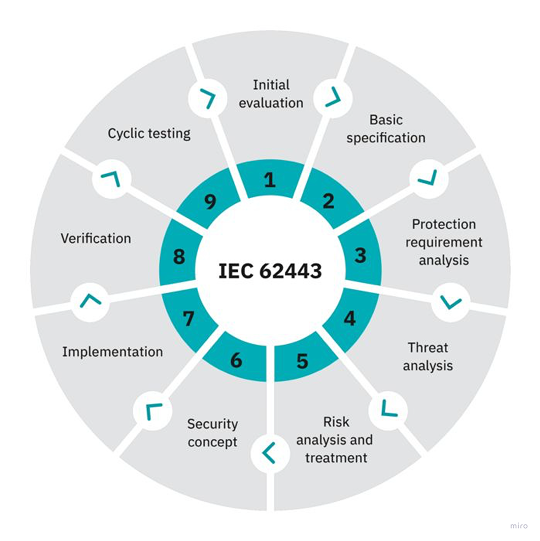
IEC 62443 is used to structure OT risk assessment by defining zones and conduits to establish trust boundaries, identifying gaps relative to required Security Levels (SL1–SL4), and evaluating exposure based on credible threat actors and realistic attack paths.
Risk is assessed in the context of safety, availability, and operational resilience, ensuring that technical findings are grounded in how OT systems function in practice. A cybersecurity Requirements specification summarises the results.
Mapping IEC 62443 to Compliance Requirements
Using IEC 62443 as the foundation for OT risk assessment provides more than just a technical framework, it offers a structured, operationally relevant lens through which organisations can evaluate and demonstrate compliance with regulatory requirements.
By translating technical security controls, zones, conduits, and security levels into compliance terms, organisations can show that their OT security posture is aligned with both international directives and sector-specific regulations.
By mapping IEC 62443 controls to relevant regulatory requirements such as NIS2, and sector-specific regulatory bodies, organisations can bridge the gap between technical OT security and business governance. This approach translates operational exposure into clear, actionable, and auditable compliance measures, enabling identification of gaps, prioritisation of mitigation actions, and demonstration of adherence to both international and industry-specific obligations while maintaining operational integrity.
Linking operational security measures to these regulatory frameworks supports a risk-informed, defensible security strategy, strengthens resilience, and facilitates reporting to executives, regulators, and auditors, ensuring that OT cyber risk management aligns with industry best practices and legal obligations.
Is your environment NIS2 ready?
Don’t wait for an audit. Bridge the gap between your technical security and your regulatory obligations